
The kW (or HP) on a motor nameplate is the mechanical output at the shaft, not the power the motor draws. Output alone does not give the current — you also need efficiency and power factor. Breakers, cables and overload relays are set from the nameplate rated current; the calculation is for when there is no nameplate or to check one.
Formulas
Three-phase:  I = P ÷ (√3 × V × η × cos φ)
Single-phase: I = P ÷ (V × η × cos φ)
DC:           I = P ÷ (V × η)
  P: rated output (W), V: voltage (line-to-line for three-phase), η: efficiency, cos φ: power factor
This combines «input power = √3 × V × I × cos φ» with «efficiency = output ÷ input» (ABB Technical guide No. 7, eq. 3.15 and 3.16). Turned around, nameplate output, voltage, current and power factor give the efficiency; ABB's example (37 kW, 380 V, 71 A, cos φ 0.85) works out to about 0.931.
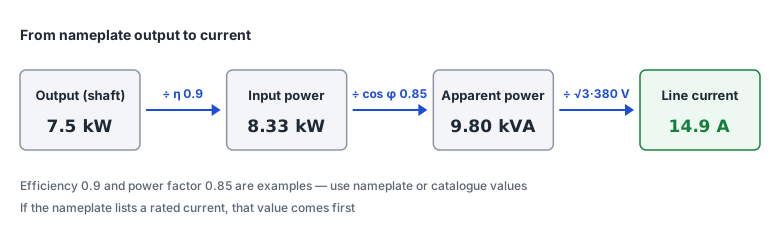
How much efficiency and power factor matter (three-phase 7.5 kW)
| Voltage | Efficiency | Power factor | Current |
|---|---|---|---|
| 380 V | 0.90 | 0.85 | 14.90 A |
| 380 V | 0.87 | 0.82 | 15.97 A |
| 380 V | 0.92 | 0.87 | 14.24 A |
| 380 V | 0.90 | 0.75 | 16.88 A |
| 220 V | 0.90 | 0.85 | 25.73 A |
| 440 V | 0.90 | 0.85 | 12.86 A |
A few percent of efficiency or power factor moves the current of the same 7.5 kW motor by 1–2 A. Both vary with size, poles and efficiency class, so «amps per kW» rules of thumb are only rough.
Why trust the nameplate over the calculation
- Part load: efficiency and power factor both drop at light load, so the current does not fall in proportion to the load.
- Tolerances: ABB's Motor guide lists, after IEC 60034-1, −15 % of (1−η) for efficiency (up to 150 kW) and −1/6 of (1−cos φ) for power factor.
- Voltage: below nameplate voltage the same output takes more current. ABB quotes the IEC 60034-1 supply tolerance as ±5 % voltage and ±2 % frequency.
Starting current
- Direct-on-line starting draws several times the rated current; take the exact ratio from the catalogue's IS/IN.
- At switch-on a transient adds on top, and the peak can reach about 2.5 times the (rms) starting current before it decays (ABB Motor guide §4.5).
- Star-delta starting cuts the starting current to about 30 % of DOL and the starting torque to about 25 %. Starting through a drive keeps the current at 0.5–1 times rated, 1.5 times at most.
- So a motor circuit breaker is chosen not to trip on the starting current, and overload protection is set separately (overload relay or the drive's electronic thermal).
Breakers and cables: the two conditions
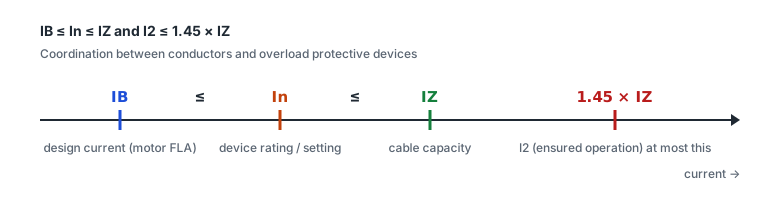
IB ≤ In ≤ IZ
I2 ≤ 1.45 × IZ
  IB: design current of the circuit   In: rated current of the protective device (setting, if adjustable)
  IZ: current-carrying capacity       I2: current ensuring effective operation within the conventional time
These are the overload coordination conditions of IEC 60364-4-43, as adopted in the Korean code (KEC 212.4.1). For a single motor, IB is the motor's rated current. In must be at least IB so normal running does not trip, and no more than IZ so the cable is protected. I2 comes from the device maker or its product standard.
Where IZ comes from
- Current-carrying capacity is taken from the tables in Annex B of IEC 60364-5-52 (KS C IEC 60364-5-52 in Korea, KEC 232.5.2), using Annex A for the installation method and applying correction factors for ambient temperature and grouping.
- The tables are based on maximum conductor temperatures of 70 °C for PVC and 90 °C for XLPE/EPR (KEC Table 232.5-1). The same size carries very different currents depending on insulation, installation method, loaded conductors and ambient temperature.
- This guide does not reproduce the tables, because we could not check the original Annex B. Use the standard itself or the cable maker's data.
- On long runs a cable can meet IZ and still drop too much voltage, so check voltage drop separately.
Read the running current over the bus
Drives publish their output current, and power meters the current they measure, as Modbus registers — for example 0x0310 on the LS S300 (output current, 0.1 A units) and 0026H on the YASKAWA A1000 (output current, scaling depends on the model). Comparing the running current with the nameplate tells you how loaded the motor is.
In PortDock
- «Motor Current Calculator» web tool: three-phase, single-phase or DC, kW or HP → current, input power, kVA and torque, plus efficiency from nameplate values.
- «Voltage Drop & Wire Size Calculator» web tool: voltage drop over the cable length.
- Modbus Master: load a device register map and read a drive's or power meter's output current in a table, with logging to file.
Published 2026-10-23