
Every site uses its own pressure units: old gauges in kgf/cm², imported machines in psi, transmitter datasheets in kPa or MPa, fans and ducts in mmH₂O (or inH₂O), vacuum in mbar or Torr. When a reading is «slightly» or «badly» off, suspect the units before the maths — the size of the error often tells you which mix-up it is.
What the size of the error suggests
| Symptom | Usual cause |
|---|---|
| About 2 % off | kgf/cm² treated as bar — 1 kgf/cm² = 0.980 665 bar |
| About 1 bar (101 kPa) off | Gauge (bar g) vs absolute (bar a) — they differ by atmospheric pressure |
| About 14.5 times | psi vs bar — 1 bar ≈ 14.504 psi |
| About 6.9 times | psi vs kPa — 1 psi ≈ 6.895 kPa |
| 10 or 1000 times | kPa, MPa and bar prefixes — 1 MPa = 10 bar = 1000 kPa |
| About 102 times | kPa vs mmH₂O — 1 kPa ≈ 101.97 mmH₂O |
kgf/cm² is not a bar
1 kgf/cm² is the force of 1 kg under standard gravity (9.806 65 m/s²) over 1 cm², i.e. 98 066.5 Pa; 1 bar is 100 000 Pa. They are about 2 % apart: 7 kgf/cm² is about 6.86 bar and 1.6 MPa is about 16.3 kgf/cm². Copying the «kg» of a drawing or old gauge straight into a bar field is off by that much.
Gauge versus absolute
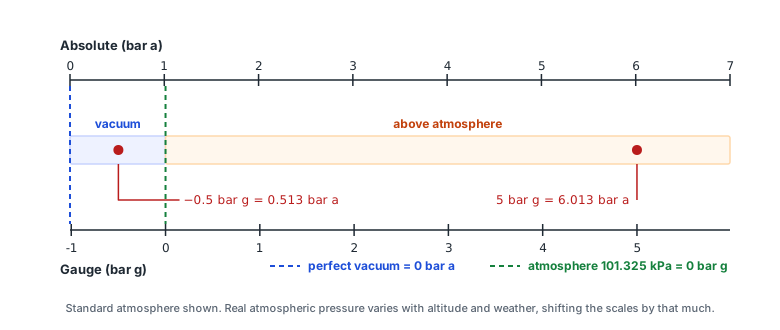
Gauge pressure (bar g, psig) takes the local atmosphere as zero; absolute pressure (bar a, psia) takes a perfect vacuum as zero. Absolute = gauge + atmospheric. With the standard 101.325 kPa, 5 bar g is about 6.013 bar a. Most process pressure transmitters are gauge types, while vacuum, steam and gas calculations often need absolute pressure. Check the «G», «A», «gauge» or «absolute» in the datasheet, and write g or a after the unit to avoid mix-ups.
A differential pressure transmitter (across a filter, an orifice flowmeter) reads the difference between two points — neither gauge nor absolute.
mmH₂O and mmHg are conventional values
One millimetre of water (mmH₂O) is defined with water at 1000 kg/m³ and standard gravity: 9.806 65 Pa. One millimetre of mercury (mmHg) uses 13 595.1 kg/m³: about 133.3224 Pa. A real water column varies slightly with temperature — NIST SP 811 lists inH₂O at 39.2 °F as 249.082 Pa and at 60 °F as 248.84 Pa, against 249.0889 Pa conventional. A fan static pressure of 250 mmH₂O is about 2.45 kPa.
Putting the sensor range into the PLC
A 4–20 mA pressure transmitter maps «range low = 4 mA, range high = 20 mA». In the PLC, either copy the transmitter's range and unit as they are or convert just the range into the unit you want. Example: to show a 0–10 bar transmitter in psi, enter 0–145.04 psi.
| Current | 0–10 bar | psi | kPa | kgf/cm² |
|---|---|---|---|---|
| 4 mA | 0 | 0 | 0 | 0 |
| 8 mA | 2.5 | 36.26 | 250 | 2.549 |
| 12 mA | 5 | 72.52 | 500 | 5.099 |
| 16 mA | 7.5 | 108.8 | 750 | 7.648 |
| 20 mA | 10 | 145.04 | 1000 | 10.197 |
Compound (vacuum and pressure) transmitters with a range such as −1–9 bar work the same way, with 4 mA at the low end. Convert both ends when changing units, and add atmospheric pressure to both to turn a gauge range into absolute.
Pressure read over Modbus
Pressure registers often carry a scale (such as 0.01) or a 32-bit float split across two registers. Check the unit, scale and word order in the device manual. For panel meters and transmitters whose unit can be changed on the device, also read the unit-setting register so the display and the bus value cannot drift apart.
In PortDock
- «Pressure Unit Converter» web tool: one value in bar, psi, kPa, MPa, kgf/cm², mmH₂O, mmHg and more; gauge ↔ absolute; a 4–20 mA table for a sensor range.
- «4–20 mA Scaling Calculator» web tool: current ↔ engineering units ↔ % ↔ PLC counts.
- Modbus Master decodes registers by type (integer or float) and word order (device profiles put the unit and scale in the column name), and PortDock Plot graphs numbers arriving over serial, TCP or UDP live.
Published 2026-10-23