
Motor Current Calculator (kW to Amps)
Motor current, input power and kVA from output (kW or HP), voltage, efficiency and power factor — three-phase, single-phase or DC. Nameplate efficiency, torque.
Formulas
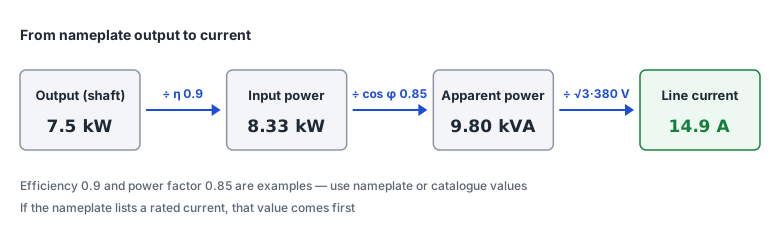
- Three-phase: I = P ÷ (√3 × V × η × cos φ)
- Single-phase: I = P ÷ (V × η × cos φ)
- DC: I = P ÷ (V × η)
- Input power = P ÷ η, apparent power kVA = input kW ÷ cos φ
- Efficiency η = P ÷ (√3 × V × I × cos φ) (from the nameplate)
- Torque N·m = P (W) ÷ (2π × r/min ÷ 60) ≈ 9549 × kW ÷ r/min
P is the rated output on the nameplate — the mechanical power at the shaft, not what the motor draws. Divide by efficiency for input power, by power factor for apparent power, then by voltage for current. For three-phase, V is the line-to-line voltage.
Why the result differs from the nameplate current
- Efficiency and power factor vary with size, poles and efficiency class, and both drop at part load, so the current of a lightly loaded motor does not fall in proportion to its load.
- Nameplate values have tolerances too. ABB's Motor guide lists, after IEC 60034-1, −15 % of (1−η) for efficiency (up to 150 kW) and −1/6 of (1−cos φ) for power factor.
- Below nameplate voltage, the same output takes more current. That is why breakers, cables and overload relays are set from the nameplate full-load current, not from a calculation.
Starting current
- Direct-on-line starting draws several times the rated current, and the first transient peak can reach about 2.5 times the (rms) starting current (ABB Motor guide §4.5). Take the exact ratio from the catalogue's IS/IN.
- Star-delta starting reduces the starting current to about 30 % of DOL and the starting torque to about 25 %.
- Starting through a drive keeps the current at 0.5–1 times rated, 1.5 times at most.
The basic breaker and cable rule (Korean KEC, from IEC 60364)
- KEC 212.4.1 sets two conditions for overload protection: IB ≤ In ≤ IZ and I2 ≤ 1.45 × IZ. IB is the design current (the motor's rated current), In the protective device's rated or set current, IZ the cable's current-carrying capacity, and I2 the current that ensures the device operates within the conventional time.
- IZ is taken from the tables in Annex B of IEC 60364-5-52 (KS C IEC 60364-5-52 in Korea, per KEC 232.5.2) by installation method, insulation and loaded conductors, then corrected for ambient temperature and grouping. Maximum conductor temperatures: PVC 70 °C, XLPE/EPR 90 °C (KEC Table 232.5-1).
- This page does not reproduce current-carrying capacity tables, because we could not check the original Annex B. Use the standard itself or the cable maker's data.
- For long runs, check voltage drop as well — it is separate from current-carrying capacity.
For voltage drop over the cable length, use the Voltage Drop & Wire Size Calculator.
To convert measured kW, kVA, amps and power factor, use the Three-Phase Power Calculator; to raise the power factor with capacitors, the Power Factor Correction Capacitor Calculator.
FAQ
What current does a 7.5 kW, 380 V three-phase motor draw?
With 90 % efficiency and 0.85 power factor: 7500 ÷ (1.732 × 380 × 0.9 × 0.85) ≈ 14.9 A. Different efficiency or power factor changes it, so the nameplate current comes first.
Is there a quick kW to amps formula?
Three-phase: I = kW × 1000 ÷ (1.732 × V × efficiency × power factor). «Amps per kW» rules of thumb vary between motors and are only rough.
How do I check the nameplate efficiency?
Enter output, voltage, current and power factor under «Check efficiency from the nameplate». ABB's worked example (37 kW, 380 V, 71 A, cos φ 0.85) gives about 0.931.
Does it work for HP motors?
Set the output unit to hp (550 ft·lbf/s ≈ 0.7457 kW) or PS (metric, ≈ 0.7355 kW).