
Pressure Unit Converter
Convert bar, psi, kPa, MPa, kgf/cm², mmH2O, inH2O, mmHg and atm at once, gauge ↔ absolute pressure, and a sensor range with a 4–20 mA table.
Factors and definitions
- 1 bar = 100 kPa = 0.1 MPa = 100 000 Pa
- 1 psi = 0.453 592 37 kg × 9.806 65 m/s² ÷ (0.0254 m)² ≈ 6894.757 Pa
- 1 kgf/cm² = 9.806 65 N ÷ 1 cm² = 98 066.5 Pa = 0.980 665 bar
- 1 mmH₂O (conventional) = 1000 kg/m³ × 9.806 65 m/s² × 1 mm = 9.806 65 Pa
- 1 mmHg (conventional) = 13 595.1 kg/m³ × 9.806 65 m/s² × 1 mm ≈ 133.3224 Pa
- 1 atm = 101 325 Pa, 1 Torr = 101 325 ÷ 760 Pa
- Absolute pressure = gauge pressure + atmospheric pressure
kgf/cm² (often written «kg/cm²») is about 2 % larger than a bar. Water and mercury columns (mmH₂O, inH₂O, mmHg) use «conventional» values — water at 1000 kg/m³, mercury at 13 595.1 kg/m³ and standard gravity. A real water column depends slightly on temperature; NIST SP 811 lists inH₂O at 39.2 °F as 249.082 Pa and at 60 °F as 248.84 Pa.
Gauge versus absolute pressure
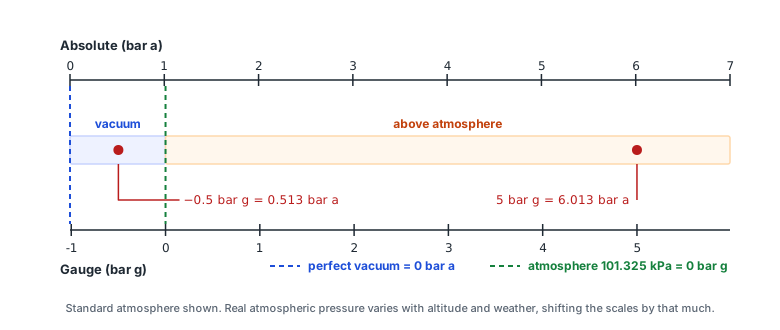
- Gauge pressure (bar g, psig) takes the local atmosphere as zero; absolute pressure (bar a, psia) takes a perfect vacuum as zero. Plant air and hydraulic gauges and most pressure transmitters read gauge pressure.
- Vacuum is negative in gauge terms (e.g. −0.5 bar g), while absolute pressure never goes below zero. Vacuum pumps and vacuum sensors are often specified in absolute units (mbar a, Torr).
- Atmospheric pressure changes with altitude and weather, so you can enter the local value instead of the standard 101.325 kPa for gauge ↔ absolute conversions.
- Differential pressure (across a filter or an orifice plate) is the difference between two points — neither gauge nor absolute. The «kPa» of a DP transmitter is a difference.
Common pressure conversions
| 1 ↓ = | bar | psi | kPa | MPa | kgf/cm² | mmH₂O | mmHg | atm |
|---|---|---|---|---|---|---|---|---|
| 1 bar | 1 | 14.5038 | 100 | 0.1 | 1.01972 | 10197.2 | 750.062 | 0.986923 |
| 1 psi | 0.0689476 | 1 | 6.89476 | 0.00689476 | 0.070307 | 703.07 | 51.7149 | 0.068046 |
| 1 kPa | 0.01 | 0.145038 | 1 | 0.001 | 0.0101972 | 101.972 | 7.50062 | 0.00986923 |
| 1 MPa | 10 | 145.038 | 1000 | 1 | 10.1972 | 101972 | 7500.62 | 9.86923 |
| 1 kgf/cm² | 0.980665 | 14.2233 | 98.0665 | 0.0980665 | 1 | 10000 | 735.559 | 0.967841 |
| 1 mmH₂O | 0.0000980665 | 0.00142233 | 0.00980665 | 0.00000980665 | 0.0001 | 1 | 0.0735559 | 0.0000967841 |
| 1 mmHg | 0.00133322 | 0.0193368 | 0.133322 | 0.000133322 | 0.00135951 | 13.5951 | 1 | 0.00131579 |
| 1 atm | 1.01325 | 14.6959 | 101.325 | 0.101325 | 1.03323 | 10332.3 | 760 | 1 |
FAQ
How many psi is 1 bar?
About 14.5038 psi. Conversely, 1 psi ≈ 0.068 948 bar (6.894 757 kPa). 100 psi ≈ 6.895 bar and 10 bar ≈ 145.04 psi.
Is kgf/cm² the same as bar?
No. 1 kgf/cm² = 0.980 665 bar, so the two differ by about 2 %. Copying «kg/cm²» from an old gauge or drawing straight into bar is off by that much.
How do I convert mmH₂O to kPa?
1 mmH₂O (conventional) = 9.806 65 Pa, so 1 kPa ≈ 101.97 mmH₂O and 100 mmH₂O ≈ 0.981 kPa. Common for fan and duct static pressure and level sensors.
My sensor is 0–10 bar but the PLC should show psi.
Only the range changes. Enter 0, 10, bar → psi in «Sensor range rescaling» to get 0–145.04 psi and the psi values at 4, 8, 12, 16 and 20 mA, then use them as the engineering-unit limits in the PLC.
To turn a current into engineering units or PLC counts, use the 4–20 mA Scaling Calculator. For the force a pneumatic cylinder delivers at that pressure, use the Pneumatic Cylinder Force Calculator.