
VFD Frequency ↔ Motor RPM Calculator
Synchronous speed from drive Hz and poles, slip from the nameplate, approximate actual and gearbox output speed, and the Hz needed for a target rpm.
Formulas
- Synchronous speed ns (r/min) = 120 × f ÷ poles
- Slip s = (ns − n) ÷ ns, slip speed = ns − n
- Rated slip (Hz) = rated frequency − rated speed × poles ÷ 120
- Speed at f ≈ 120 × f ÷ poles − rated slip speed (approximation)
- Required frequency ≈ (target rpm × gear ratio + slip speed) × poles ÷ 120
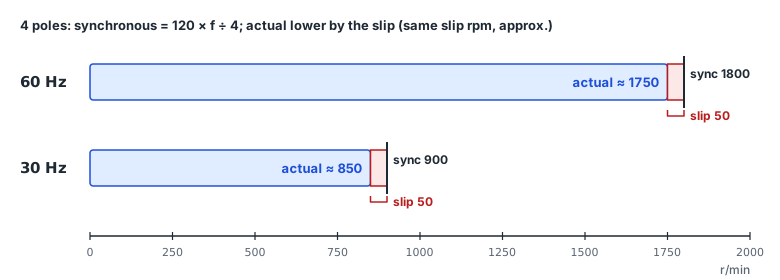
An induction motor runs slightly slower than synchronous speed (slip). A 4-pole motor at 60 Hz has a synchronous speed of 1800 r/min, but its nameplate says something like 1750 r/min — the 50 r/min difference is the slip at rated load. Expressed in hertz (60 − 1750 × 4 ÷ 120 ≈ 1.67 Hz) it has the same form as a drive's «rated slip» parameter (e.g. YASKAWA A1000 E2-02).
Why «approximate»
- Below base frequency with constant V/f, the slip speed at a given torque is taken as nearly unchanged. So 30 Hz on a 4-pole motor gives a 900 r/min synchronous speed minus 50 r/min, about 850 r/min.
- Real slip changes with load torque: closer to synchronous speed when lightly loaded, slower when heavily loaded.
- With slip compensation or vector control, the drive raises the frequency by the slip to hold the commanded speed, so the synchronous figure is closer to reality.
- Nameplate speed has a tolerance too. ABB's Motor guide gives, after IEC 60034-1, a slip tolerance of ±20 % (1 kW and above) and ±30 % (below 1 kW).
Synchronous speed by poles (r/min)
| Poles | 50 Hz | 60 Hz | 10 Hz | 30 Hz | 90 Hz |
|---|---|---|---|---|---|
| 2 | 3000 | 3600 | 600 | 1800 | 5400 |
| 4 | 1500 | 1800 | 300 | 900 | 2700 |
| 6 | 1000 | 1200 | 200 | 600 | 1800 |
| 8 | 750 | 900 | 150 | 450 | 1350 |
| 10 | 600 | 720 | 120 | 360 | 1080 |
| 12 | 500 | 600 | 100 | 300 | 900 |
The rpm shown on the drive
Drives can display output frequency converted to rpm using the pole setting. On the LS S300, DRV-32 (Hz/rpm Select) = 1 switches to rpm, and the value depends on the pole number setting (MOT1, 2-25; 4-pole basis). On the YASKAWA A1000, o1-03 = 2 shows r/min calculated from the maximum output frequency and the number of motor poles (E2-04). If the pole setting does not match the motor, the rpm display is wrong.
FAQ
What rpm is a 4-pole motor at 60 Hz?
Synchronous speed is 120 × 60 ÷ 4 = 1800 r/min; the actual rated speed is lower by the slip, so the nameplate shows a smaller figure (e.g. 1750 r/min). At 50 Hz the synchronous speed is 1500 r/min.
Does 30 Hz halve the speed?
The synchronous speed is exactly half (900 r/min for 4 poles). The real speed is lower by the slip speed, so at rated load it is a little under half (about 850 r/min for a 1750 r/min nameplate).
What frequency gives the rpm I want?
Enter the rpm in «Target output shaft speed»; gear ratio and slip are added to give the frequency. With slip compensation, set it from synchronous speed without the slip.
What if I do not know the number of poles?
Estimate it from the nameplate rated frequency and speed: find the synchronous speed just above the rated speed (at 60 Hz, 3500s → 2 poles, 1700s → 4 poles, 1100s → 6 poles).
For the motor's rated current and torque, use the Motor Current Calculator.
To measure the real speed with an encoder, use the Encoder Pulses ↔ RPM Calculator. For the motor speed and torque a ball screw axis needs, use the Ball Screw Torque & Motor Sizing Calculator.
Sources
- ABB, Low voltage motors — Motor guide (2019): §3.8 Tolerances, §9.3 Speed (synchronous speed = frequency × 120 ÷ poles)
- ABB, Technical guide No. 7 (3AFE64362569 Rev D): eq. 3.1–3.2 (slip, synchronous speed), Fig. 3.2
- YASKAWA AC Drive A1000 Technical Manual (SIEP C710616 41H): E2-02 Motor Rated Slip, o1-03
- LS ELECTRIC LSLV-S300 User's Manual: 5.1.2.3 Changing Unit of Speed (DRV-32), Formula 16