
Process temperature sensors come in two main kinds: resistance temperature detectors (RTDs, typically Pt100) and thermocouples. An RTD measures a platinum resistance that changes with temperature; a thermocouple measures the thermoelectric voltage (mV) at the junction of two different metals. The resistance and voltage values below are calculated from the IEC 60751 equation and the NIST ITS-90 thermocouple tables (SRD 60).
Pt100: 100 Ω at 0 °C
| Temperature | Pt100 resistance |
|---|---|
| −200 °C | 18.52 Ω |
| −100 °C | 60.26 Ω |
| 0 °C | 100.00 Ω |
| 100 °C | 138.51 Ω |
| 200 °C | 175.86 Ω |
| 400 °C | 247.09 Ω |
| 850 °C | 390.48 Ω |
Near 0 °C the resistance changes by about 0.39 Ω per °C (IEC 60751, α = 0.00385), so a 0.39 Ω resistance error is about a 1 °C temperature error. A Pt1000 follows the same equation with ten times the resistance.
2-wire, 3-wire and 4-wire
| Connection | What is measured | Effect of lead resistance |
|---|---|---|
| 2-wire | Sensor plus both leads together | Added in full — reads high |
| 3-wire | A third lead measures lead resistance to subtract it | Cancelled when all three leads are equal |
| 4-wire | Separate current leads and voltage-sensing leads | Negligible — almost no current in the sensing leads |
With 1 Ω of total lead resistance on a 2-wire connection, a Pt100 reads about 2.6 °C high at 0 °C and a Pt1000 about 0.26 °C. Longer and thinner leads have more resistance, so 2-wire suits short runs or Pt1000. 3-wire cancels only when the three leads match in length, gauge and contact resistance; a loose terminal or a splice to a different gauge leaves an error. For higher accuracy use 4-wire.
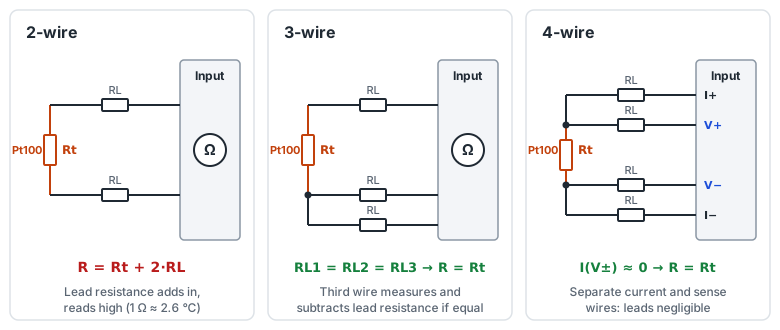
Start from what the receiving input (temperature controller, transmitter) accepts. To connect a 2-wire sensor to a 3-wire input, follow the terminal instructions in the input's manual.
Tolerance classes (IEC 60751)
IEC 60751 grades the sensor's own tolerance. Class A is ±(0.15 + 0.002·|t|) °C and class B ±(0.3 + 0.005·|t|) °C — ±0.15 °C and ±0.3 °C at 0 °C, ±0.35 °C and ±0.8 °C at 100 °C. A tighter class AA and a looser class C also exist. Each class is valid over its own temperature range, different for wire-wound and thin-film elements, so check the sensor datasheet. The class covers the sensor; 2-wire lead error comes on top.
Thermocouple types
| Type | Materials (+ / −) | NIST table range | EMF at 100 °C |
|---|---|---|---|
| K | Nickel-chromium / nickel-aluminum | −270 to 1372 °C | 4.096 mV |
| J | Iron / copper-nickel | −210 to 1200 °C | 5.269 mV |
| T | Copper / copper-nickel | −270 to 400 °C | 4.279 mV |
| E | Nickel-chromium / copper-nickel | −270 to 1000 °C | 6.319 mV |
| N | Nicrosil / nisil | −270 to 1300 °C | 2.774 mV |
| R | Platinum-13% rhodium / platinum | −50 to 1768.1 °C | 0.647 mV |
| S | Platinum-10% rhodium / platinum | −50 to 1768.1 °C | 0.646 mV |
| B | Platinum-30% rhodium / platinum-6% rhodium | 0 to 1820 °C | 0.033 mV |
The NIST range is where the EMF equations are defined. The usable upper limit is lower depending on wire gauge and sheath, so follow the sensor maker's specification.
What to consider when choosing
- Check that the receiving input supports the type. If the input is set to a different type, the same mV reads as a different temperature — 4.096 mV is 100 °C as type K but about 78 °C read as type J.
- A larger mV at the same temperature makes noise relatively smaller. At 100 °C, types E, J, T and K give 4.1–6.3 mV, R and S about 0.65 mV, and B 0.033 mV.
- Above 1372 °C the platinum types (R, S, B) cover the tables. Type B produces almost nothing near room temperature (−0.002 mV at 25 °C), so cold-junction compensation matters little, but its signal is too small at low temperatures.
- To extend between the sensor and the input, use extension or compensating cable of the same type. Plain copper creates new junctions at the splice and adds error.
Cold-junction compensation
A thermocouple's mV depends on the temperature difference between the measuring tip and the input terminals (the cold junction). NIST tables assume a 0 °C cold junction, so the instrument measures its terminal temperature and adds the corresponding voltage. Example: measuring 300 °C with type K and terminals at 25 °C gives 11.208 mV. Looking that up as if the cold junction were 0 °C gives about 275.8 °C — some 24 °C low.
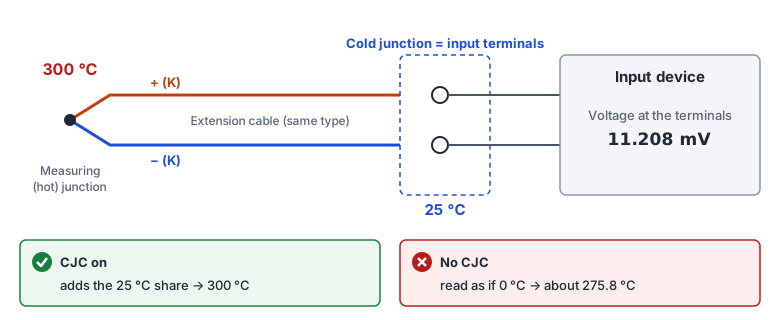
- Reads consistently low (or high) by about room temperature: compensation is off or applied twice.
- Reading falls while heating: + and − are reversed (including the extension cable).
- Reading jumps to maximum or minimum: open circuit. Check the input's burnout indication.
In PortDock
- «Pt100 & Thermocouple Converter» web tool: Pt100, Pt500 and Pt1000 resistance ↔ temperature and type K, J, T, E, N, R, S, B mV ↔ temperature, with cold-junction compensation and tables.
- Read a temperature controller's process value and setpoint with Modbus Master and watch them on its trend lines. This site's register maps include the Autonics TK and TX and the Hanyoung Nux VX temperature controllers.
Published 2026-10-22