
RS-232, RS-422 and RS-485 define how electrical signals travel (the physical layer), not what the bytes mean (the protocol). The same Modbus RTU can run over any of them with the same baud and parity settings. What differs is the wiring, the distance and how many devices share a line. The figures below follow the TIA/EIA summary in TI's application report «Comparing Bus Solutions» (SLLA067C).
| RS-232 | RS-422 | RS-485 | |
|---|---|---|---|
| Signal | Single-ended (voltage to GND) | Differential (voltage between two wires) | Differential |
| Topology | Point-to-point | 1 driver : up to 10 receivers | Many transceivers share one line (32 unit loads) |
| Direction | Separate transmit and receive wires | One direction per pair (two pairs for both) | 2-wire half duplex or 4-wire full duplex |
| Distance | About 20 m (line capacitance under 2500 pF) | Up to 1200 m | Up to 1200 m |
| Receiver threshold | ±3 V | 200 mV differential | 200 mV differential |
| Common-mode voltage | — | Up to 7 V | −7 to +12 V |
| Termination | None | Far end from the driver | Both ends of the line |
Distance and speed cannot both be at their maximum. 1200 m applies at low speeds; high speeds need short lines.
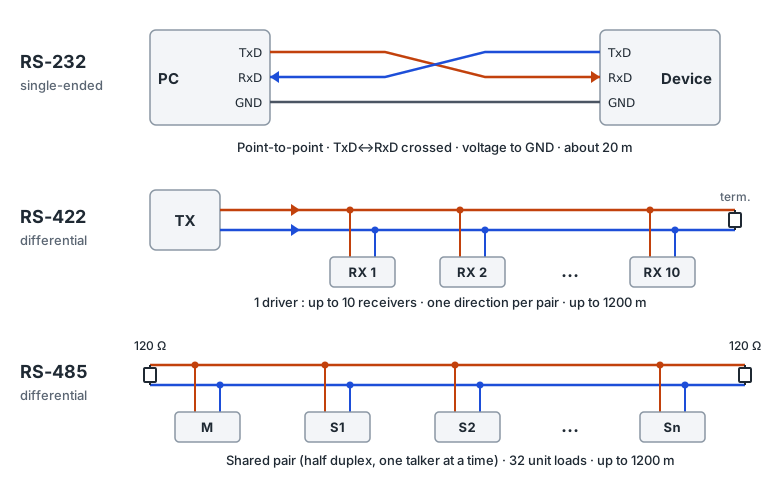
RS-232: short point-to-point
Transmit (TxD), receive (RxD) and ground (GND) are the basic three wires, and signals are voltages relative to GND (±5 to 15 V at the driver; the receiver decides above +3 V or below −3 V). It suits short point-to-point links such as a PC COM port or a device's configuration port. Two devices of the same kind (DTE) need a null-modem cable that crosses TxD and RxD. If nothing answers at all, check whether transmit and receive are crossed correctly.
RS-485: many devices on one line
Differential signalling resists noise and ground potential differences between devices (common mode −7 to +12 V). With standard transceivers (one unit load, about 12 kΩ) a line takes 32 devices; with 1/8 unit-load transceivers, 256. Two-wire RS-485 sends and receives on the same pair, so only one device may talk at a time (half duplex) — a natural fit for Modbus RTU, where the master asks and one slave answers.
Termination, biasing, A/B polarity and ground are covered in the RS-485 wiring checklist.
RS-422: one driver, several receivers
Differential like RS-485, so it also runs long distances, but each pair has only one driver and up to 10 receivers. Two-way links use two pairs (four wires), one per direction. Because the wiring resembles 4-wire RS-485, one adapter often supports both — look for «RS-422 / RS-485 4W» in the adapter manual.
How to choose
| Situation | Choose |
|---|---|
| PC and one device, a few metres | RS-232 (if the device has it) |
| Several devices on one master | RS-485 two-wire |
| Tens of metres or more, near drives and other noise | RS-485 or RS-422 (differential) |
| Long point-to-point link, sending and receiving at once | RS-422 or 4-wire RS-485 |
In the end the device's port decides. If it only has RS-485, use a USB-RS485 adapter on the PC. To extend an RS-232 device, an RS-232 ↔ RS-485 converter at each end is an option.
Choosing an adapter
- Two-wire RS-485 adapters need direction control that enables the driver only while sending. Check whether it is automatic or switched by RTS.
- Some two-wire adapters echo your own bytes back to the receiver. If the log shows your transmitted bytes coming back, that is the echo.
- USB adapters batch received data, which can affect Modbus RTU framing — see the USB-serial adapter latency guide.
In PortDock
- Serial: all three appear in Windows as the same kind of COM port. Opening the port and exchanging hex bytes checks the wiring regardless of protocol.
- Modbus Master skips the echo of a two-wire RS-485 adapter automatically.
- «Web Serial Terminal» web tool: open a COM port in the browser without installing anything (in browsers that support Web Serial).
Published 2026-10-22